As Finance Minister Nirmala Sitharaman presented the Union Budget 2026 today, India marked a defining fiscal moment. This was her ninth consecutive budget under the leadership of Prime Minister Narendra Modi and the first time in India’s fiscal history that the Union Budget was presented on a Sunday. The budget came at a time when the Indian economy has been demonstrating resilience amid global uncertainty.
According to the Economic Survey 2026, India’s GDP is projected to grow by 7.4% in FY26 and between 6.8% and 7.2% in FY27, supported by a strong macroeconomic foundation, continued regulatory reforms, and a renewed push for private sector investment. Against this backdrop, Budget 2026 has sought to balance growth priorities with fiscal prudence, while laying the groundwork for long-term economic stability.
Budget 2026 inspired by Three 'Kartavya'
-
Accelerating and sustaining economic growth by enhancing competitiveness and building resilience to global volatility
-
Fulfilling the aspirations of citizens by strengthening capabilities and enabling them to be active partners in India’s growth journey
-
Ensuring sab ka saath, sab ka vikas by expanding access to resources, amenities, and opportunities across regions and communities
Budget 2026: What Is Needed To Achieve Three 'Kartavya'
The threefold approach requires a supportive ecosystem. It includes:
- Sustain the momentum of structural reforms
- Robust and resilient financial sector
- Cutting-edge technologies, including AI
As the budget announcements unfold, this blog will capture the latest updates, key policy measures, and sector-wise implications, offering timely insights into what Union Budget 2026 means for businesses, MSMEs, taxpayers, and the broader economy.
Download Budget 2026 document here.
Download Budget 2026 speech here.
Download Budget 2026 highlights here.
Live Updates from Union Budget 2026
Feb 01, 2026 12:47 (IST)
Budget 2026 Live: Nirmala Sitharaman Introduces Finance Bill
Union Finance Minister Nirmala Sitharaman has introduced the Finance Bill 2026 in the Lok Sabha. Speaker Om Birla has adjourned the House. The House will reconvene on Monday.
Feb 01, 2026 12:47 (IST)
Budget 2026 Live: TAN No Longer Needed For TDS On NRI Property Deals
Finance Minister Nirmala Sitharaman on Sunday simplified Tax Deducted at Source (TDS) on property sales by non-residents. Resident buyers can now deduct and deposit TDS using a PAN-based challan, removing the need to apply for a Tax Deduction Account Number (TAN), she announced in the Union Budget 2026.
"TDS on sale of immobile property by a non-resident is proposed to be deducted and deposited through the resident buyer and his or her PAN-based challan. Instead of requiring a tan, which is a temporary accounting number," the Finance Minister said, presenting her ninth consecutive Budget.
Feb 01, 2026 12:44 (IST)
Union Budget 2026: FM Sitharaman announces buyback tax, higher STT on commodity futures, MAT rate reduced to 14%
Finance minister Nirmala Sitharaman on Sunday announced that buyback proceeds for all shareholders will be taxed as capital gains. Presenting the Union Budget for 2026–27, she also proposed increasing the Securities Transaction Tax on commodity futures from 0.02 per cent to 0.05 per cent. Additionally, she said the Minimum Alternate Tax (MAT) will be treated as the final tax, with the rate reduced from 15 per cent to 14 per cent.
Feb 01, 2026 12:43 (IST)
Budget 2026: Electronics outlay increased to 40,000 crores
The budget proposes increasing the Electronics Components Manufacturing Scheme outlay from Rs 22,999 crore to Rs 40,000 crore, alongside new initiatives such as ISM 2.0, rare earth corridors, and dedicated chemical parks. These measures aim to strengthen India’s semiconductor ecosystem, reduce import dependency, and support states in developing advanced industrial corridors that boost domestic manufacturing competitiveness.
Key points:
- ISM 2.0 launch: A new phase focused on producing equipment and materials, designing full-stack Indian IP, and strengthening semiconductor supply chains.
- Electronics Components Manufacturing Scheme: Outlay raised to Rs 40,000 crore after investment commitments doubled the original Rs 22,999 crore target.
- Rare earth corridors: Proposed support for Odisha, Kerala, Andhra Pradesh, and Tamil Nadu to establish dedicated corridors for mining, processing, research, and manufacturing.
- Chemical parks: A scheme to help states set up three dedicated chemical parks through a cluster-based plug-and-play model, reducing import dependency.
Feb 01, 2026 12:42 (IST)
Budget 2026 Live: What Aviation Sector Got In Union Budget 2026
Finance Minister Nirmala Sitharaman, presenting the Union Budget 2026 today, announced basic customs duty exemption on raw materials for the manufacturing of aircraft parts for maintenance, repair and other units in the defence sector.
Other initiatives include incentives for the indigenisation of seaplane manufacturing and subsidies for seaplane flights.
The Finance Minister also announced basic customs duty exemption on component parts for the manufacturing of civilian and other aircraft.
Feb 01, 2026 12:38 (IST)
Budget 2026 Live: Duty Relief On 17 Essential Cancer Drugs
In the Union Budget 2026, the government announced targeted relief for cancer patients by exempting basic customs duty on 17 essential cancer drugs and medicines, aimed at reducing treatment costs.
In addition, seven more rare diseases will be brought under duty exemptions for personal imports of drugs, medicines and foods for special medical needs used in cancer care, expanding financial support for patients requiring specialised therapies.
Feb 01, 2026 12:29 (IST)
Budget 2026 Live: Duty-Free Fish catch By Indian fishing Vessels
Fish catch by Indian fishing vessels on the high seas to be made duty-free.
Feb 01, 2026 12:28 (IST)
Budget 2026 Live: Cargo Clearance To Be Made Seamless
Approvals required for cargo clearance to be seamlessly processed through the digital window by the end of the financial year.
Feb 01, 2026 12:27 (IST)
Budget 2026 Live: No Customs Duty On Microwave Ovens Parts
Union Finance Minister Nirmala Sitharaman proposed to exempt basic customs duty on specified parts for microwave ovens.
Feb 01, 2026 12:27 (IST)
Budget 2026 Live: No Customs Duty On Raw Materials For Manufacture Of Parts For Aviation
Union Finance Minister Nirmala Sitharaman proposed to exempt customs duty on raw materials for the manufacture of parts for aviation.
Feb 01, 2026 12:25 (IST)
Budget 2026 Live: No Customs Duty On Imports Of Goods For Nuclear Power Projects Till 2035
No customs duty on imports of goods for nuclear power projects till 2035.
Feb 01, 2026 12:24 (IST)
Budget 2026 Live: No Customs Duty On Sodium Antimonate
No customs duty on sodium antimonate for use in the manufacture of solar glass.
Feb 01, 2026 12:23 (IST)
Budget 2026 Live: Sensex Down By 800 Points
Sensex slides down by 800 points amid Union Budget 2026 presentation.
Feb 01, 2026 12:23 (IST)
Budget 2026 Live: No Customs Duty On Goods Used To Manufacture Battery Energy Storage System
To extend basic customs duty exemption for capital goods used to manufacture Battery Energy Storage System (BESS).
Feb 01, 2026 12:21 (IST)
Budget 2026 Live: Leather Goods To Get Cheaper
To allow duty free imports of specified inputs available for exports of leather.
Feb 01, 2026 12:20 (IST)
Budget 2026 Live: Seafood To Get Cheaper
Sitharaman proposed to increase the limit for duty-free imports of specified inputs for processing seafood for export to 3% from 1% of the FOB value
Feb 01, 2026 12:19 (IST)
Budget 2026 Live: Final Tax Rate Reduced To 14%
Rate of final tax to be reduced to 14% from current Minimum Alternate Tax (MAT) rate of 15%
Feb 01, 2026 12:18 (IST)
Budget 2026 Live: Buyback For All Types Of Shareholders As Capital Gains To Be Taxed
Union Finance Minister Nirmala Sitharaman proposed a change in the taxation of buybacks to address improper use. The government will tax buybacks for all types of shareholders as capital gains.
- The government is to disincentivise misuse of tax arbitrage, and promoters are to pay additional buyback tax
- Effective tax on corporate promoters to be 22%; non-corporate promoters to have tax of 30% on buybacks
Feb 01, 2026 12:16 (IST)
Union Budget 2026 Live: Income Tax Act 2025 to come into effect from April 1, 2026
The Income Tax Act, 2025, is set to come into effect from 1 April 2026, featuring simplified rules, redesigned forms, and multiple direct tax relief measures, including lower TCS rates and new exemptions. These reforms aim to ease compliance for taxpayers, reduce tax burdens on specific transactions, and eliminate ambiguities impacting individuals and service providers.
- Income Tax Act 2025: New income tax framework to take effect from 1 April 2026 with simplified rules and redesigned forms.
- Motor Accident Compensation: Interest awarded by the Motor Accident Claims Tribunal to natural persons exempted from income tax.
- TCS Rates: Reduction of TCS on overseas tour program packages and on LRS remittances for education and medical purposes to 2%.
- Manpower Services: Supply of manpower services brought under contractor payments for TDS purposes to eliminate ambiguity.
Feb 01, 2026 12:15 (IST)
Budget 2026 Live: Tax Holiday Till 2047 For Foreign Companies
A tax holiday till 2047 to any foreign company that provides cloud services by setting up data centres in India.
Feb 01, 2026 12:14 (IST)
Budget 2026 Live: IT Services In Focus
- All IT services to be clubbed under a single category with a common safe harbour margin of 15.5%
- The threshold for availing safe harbour for IT services is to be enhanced to Rs 2000 crore from Rs 300 crore.
- Safe harbour for IT services to be approved by an automatic rule-driven model
Feb 01, 2026 12:12 (IST)
Budget 2026 Live: Update On ITR Dates
Individuals with ITR1 and ITR2 to continue to file till July 31. Non-audit business cases and trusts will be allowed to file returns till August 31.
Feb 01, 2026 12:09 (IST)
Budget 2026 Live: Non-Debt Receipts Estimated At Rs 36.5 Lakh Crore In FY27
Non-debt receipts estimated at Rs 36.5 lakh crore in FY27.
Feb 01, 2026 12:09 (IST)
Budget 2026 Live: Capex Spend In FY26 Estimated At Rs 11 Lakh Crore
Capex spend in FY26 estimated at Rs 11 lakh crore.
Feb 01, 2026 12:08 (IST)
Budget 2026 Live: Net Tax Receipts Estimated At Rs 28.7 Lakh Crore
Net tax receipts estimated at Rs 28.7 lakh crore in FY27.
Feb 01, 2026 12:08 (IST)
Budget 2026 Live: FY27 Net Market Borrowing From Dated Securities Estimated At Rs 11.7 lakh Crore
FY27 net market borrowing from dated securities estimated at Rs 11.7 lakh crore.
Feb 01, 2026 12:07 (IST)
Budget 2026 Live: Revised Estimates Of Expenditure In FY26 Were Rs 49.6 Lakh Crore
Revised estimates of expenditure in FY26 were Rs 49.6 lakh crore.
FY27 expenditure estimated at Rs 53.5 lakh crore.
Feb 01, 2026 12:05 (IST)
Budget 2026 Live: Fiscal Deficit Below 4.5% Of GDP
Fulfilled commitment made in FY22 to reduce the fiscal deficit below 4.5% of GDP: Nirmala Sitharaman
In Revised Estimates 2025-26, the fiscal deficit is at 4.4% of GDP.
In line with the new fiscal prudence path, the fiscal deficit is estimated at 4.3% of GDP in FY27.
Feb 01, 2026 12:05 (IST)
Budget 2026 Live: Debt To GDP Ratio
Debt to GDP ratio estimated at 55.6% of GDP in Budget Estimates 2026-27 vs 56.1% in Revised Estimates 25-26.
Feb 01, 2026 12:04 (IST)
Budget 2026 Live: States To Get Rs 1.4 lakh Crore As Finance Commission Grants
Provided Rs 1.4 lakh crore to states for FY27 as Finance Commission Grants.
Feb 01, 2026 12:03 (IST)
Budget 2026 Live: Scheme For Development Of Buddhist Circuits In North-East States
North-Eastern Region is a civilisational confluence, said Nirmala Sitharaman as she proposed to launch a scheme for the development of Buddhist circuits in multiple North-East states.
Feb 01, 2026 12:02 (IST)
Budget 2026 Live: East Coast Development Corridor
Union Finance Minister Nirmala Sitharaman proposed the development of the East Coast Development Corridor to support five 5 tourism hubs in Purvodaya states.
Feb 01, 2026 12:01 (IST)
Budget 2026 Live: Self-Help Entrepreneur Marts To Support Women Entrepreneurship
Self-Help Entrepreneur (SHE) Marts to support women entrepreneurship.
Feb 01, 2026 12:00 (IST)
Budget 2026 Live: Focused Cultivation Of Sandalwood
Since Sandalwood is closely linked to India's cultural heritage, the government proposed focused cultivation of Sandalwood.
Feb 01, 2026 12:00 (IST)
Budget 2026 Live: Targeted Effort To Increase Farmer Income
- To provide special attention to small farmers
- To empower the vulnerable to access mental health and trauma care
- To undertake initiatives to develop 500 reservoirs
- To strengthen the fisheries value chain in coastal areas
- To support animal husbandry through a credit-linked subsidy programme
- To encourage the creation of livestock farmer producer organisations
- To support high-value crops such as coconut, sandalwood, and cashew in coastal areas
- To support the generation of walnuts in hilly regions
- To enhance competitiveness in coconut production
- To launch a dedicated programme proposed for the Indian cashew and cocoa
Feb 01, 2026 11:57 (IST)
Budget 2026 Live: Khelo India Mission Launch
The Union Budget 2026 proposes to launch the Khelo India mission to transform sport sector over the next decade.
Feb 01, 2026 11:57 (IST)
Budget 2026 Live: National Institute Of Hospitality To Be Set Up
The government plans to set up a National Institute of Hospitality and proposes a scheme for training guides in tourism hubs in India.
India has potential and opportunity to offer world-class trekking, hiking destinations, added Sitharaman. Turtle trails along key nesting sites in Odisha, Karnataka, and Kerala are to be developed. Additionally, 15 archaeological sites across the country will be developed.
Feb 01, 2026 11:54 (IST)
Budget 2026 Live: Indian Design Industry Expanding Rapidly
The government to establish through challenge route new national institute of design in East India. The government to support states through challenge routes to create five university townships. Planned academic zones to host multiple colleges, skill centres, residential areas.
Feb 01, 2026 11:53 (IST)
Budget 2026 Live: Animation, Visual Effects, Gaming Sector
India's animation, visual effects, and gaming sector is growing industry, said Finance Minister Nirmala Sitharaman and proposed to support the Indian Institute of Creative Technologies in Mumbai to set up labs across the country.
Feb 01, 2026 11:52 (IST)
Budget 2026 Live: Upgrade WHO Traditional Medical Centre In Jamnagar
The government plans to upgrade WHO traditional medical centre in Jamnagar.
Feb 01, 2026 11:52 (IST)
Budget 2026 Live: 3 New All India Institutes Of Ayurveda To Be Set Up
Exporting quality Ayurveda products helps farmers who grow the herbs, said N Sitharaman. The government plans to set up three new All India Institutes of Ayurveda and upgrade Ayush pharmacies.
Feb 01, 2026 11:50 (IST)
Budget 2026 Live
Union Finance Minister Nirmala Sitharaman proposed to launch a scheme to support states in setting up five regional medical hubs. These medical hubs will have Ayush centres, infrastructure for diagnostics and post-care rehabilitation.
Medical hubs to provide diverse job opportunities for medical service providers.
Feb 01, 2026 11:49 (IST)
Budget 2026 Live: 1.5 Lakh Caregivers To Be Trained
1.5 lakh caregivers to be trained in the coming year. Hubs for medical value tourism to be created.
Feb 01, 2026 11:48 (IST)
Budget 2026 Live: Existing Institutions For Allied Health Professionals To Be Upgraded
Existing institutions for allied health professionals will be upgraded, said Union Finance Minister Nirmala Sitharaman. Additionally, new AHP institutes will be set up in the private and government sectors.
A strong care system covering geriatric and allied sectors to be built, she added.
Feb 01, 2026 11:47 (IST)
Budget 2026 Live: Education-To-Employment Standing Committee To Be Established
The government plans to set up a high-powered education-to-employment standing committee. This Committee will prioritise areas to optimise potential for growth in the services space and review the impact of new technology like AI on the services sector.
Feb 01, 2026 11:44 (IST)
Budget 2026 Live: 25 Crore People Have Moved Out Of Multi-Dimentional Poverty Over 10 Years
Close to 25 crore individuals have come out of multi-dimentional poverty over 10 years, said Finance Minister Nirmala Sitharaman.
Feb 01, 2026 11:43 (IST)
Budget 2026 Live: Foreigners Can Buy Indian Stocks Directly Now
Individual persons resident outside India will be permitted to invest in equity through the Portfolio Investment Scheme.
The individual limit is set to be increased from 5% to 10%, while the combined cap for all such investors is proposed to rise from 10% to 24%. This change would allow serious foreign individual investors to take more meaningful stakes in Indian companies, potentially improving price discovery, deepening shareholding, and supporting long-term capital formation.
Feb 01, 2026 11:41 (IST)
Budget 2026 Live: Government To Review Foreign Exchange Management Framework
The government will introduce a market-making framework to promote the corporate bond market.
Feb 01, 2026 11:40 (IST)
Budget 2026 Live: Government To Review Foreign Exchange Management Framework
The government will introduce a market-making framework to promote the corporate bond market.
Feb 01, 2026 11:39 (IST)
Budget 2026 Live: High-Level Committee On Banking For Viksit Bharat
Union Finance Minister Nirmala Sitharaman proposed setting up a high-level committee on banking for Viksit Bharat. This committee will comprehensively review the banking sector.
A proposal to restructure Power Finance Corporation (PFC) and REC Limited (formerly Rural Electrification Corporation), two of India's premier, state-owned non-banking financial companies (NBFCs) under the Ministry of Power, has been laid.
Feb 01, 2026 11:36 (IST)
Budget 2026 Live: 7 High Speed Rail Corridors To Be Developed Between Cities As Growth Connectors
The government plans to develop seven high-speed rail corridors between cities as growth connectors. This includes Mumbai-Pune, Hyderabad-Pune, Hyderabad-Bengaluru, Chennai-Bengaluru, Delhi-Varanasi, Varanasi-Silliguri.
Feb 01, 2026 11:33 (IST)
Budget 2026 Live: Plan To Operationalise 20 New National Waterways Over 5 Years
- The government plans to operationalise 20 new National waterways over the next five years
- Training institutes will be set up as regional institutes of excellence in waterways space
- Ship repair ecosystem catering to inland waterways will be set up in Varanasi and Patna
- The government also plans to launch a coastal cargo scheme to increase the share of coastal shipping and inland waterways
- To enhance last-mile, remote connectivity to give support to the manufacturing of seaplanes
Feb 01, 2026 11:32 (IST)
Budget 2026 Live: Proposal To Set Infrastructure Risk Guarantee Fund
Union Finance Minister Nirmala Sitharaman proposed to set up the Infrastructure Risk Guarantee Fund. She also proposed setting up of dedicated Real Estate Investment Trusts (REITs) to recycle assets of Central Public Sector Enterprises (CPSEs).
Feb 01, 2026 11:30 (IST)
Budget 2026 Live: In FY27, Capital Expenditure Set At Rs 12.2 Lakh Crore
For the Financial Year 2027, the capital expenditure has been set at Rs 12.2 lakh crore.
Feb 01, 2026 11:29 (IST)
Budget 2026 Live: Public Capital Expenditure Gets Rs 11 Lakh Crore
Public capital expenditure has increased manifold to an allocation of 11 lakh crore in the Budget Estimates 26.
Feb 01, 2026 11:33 (IST)
Budget 2026 Live: Plan To Operationalise 20 New National Waterways Over 5 Years
The government plans to operationalise 20 new National waterways over the next five years.
Feb 01, 2026 11:32 (IST)
Budget 2026 Live: Proposal To Set Infrastructure Risk Guarantee Fund
Union Finance Minister Nirmala Sitharaman proposed to set up the Infrastructure Risk Guarantee Fund. She also proposed setting up of dedicated Real Estate Investment Trusts (REITs) to recycle assets of Central Public Sector Enterprises (CPSEs).
Feb 01, 2026 11:30 (IST)
Budget 2026 Live: In FY27, Capital Expenditure Set At Rs 12.2 Lakh Crore
For the Financial Year 2027, the capital expenditure has been set at Rs 12.2 lakh crore.
Feb 01, 2026 11:29 (IST)
Budget 2026 Live: Public Capital Expenditure Gets Rs 11 Lakh Crore
Public capital expenditure has increased manifold to an allocation of 11 lakh crore in the Budget Estimates 26.
Feb 01, 2026 11:28 (IST)
Budget 2026 Live: Continued Focus On Developing Infrastructre In Tier-2 And Tier-3 Cities
The government plans to continue to focus on developing infrastructure in tier-2 and tier-3 cities.
Feb 01, 2026 11:27 (IST)
Budget 2026 Live: Modular Courses To Train 'Corporate Mitras'
The government plans to facilitate the creation of modular courses to train 'Corporate Mitras'. Corporate Mitras to help MSMEs ensure regulatory compliance.
Feb 01, 2026 11:26 (IST)
Budget 2026 Live
Finance Minister Nirmala Sitharaman proposed to link GeM (Government e-Marketplace) integrated with TReDS (Trade Receivables electronic Discounting System), for information sharing.
Also, to introduce TReDS receivables as asset-backed securities.
Feb 01, 2026 11:25 (IST)
Budget 2026 Live: Self Reliant Funds
Self-reliant India fund gets Rs 2000 crore to continue support to micro enterprises.
Feb 01, 2026 11:25 (IST)
Budget 2026 Live: Rs 10,000 Crore SME Growth Fund
Finance Minister Nirmala Sitharaman proposed to introduce Rs 10,000 crore SME growth fund. The idea is to incentivise SMEs based on select criteria.
Feb 01, 2026 11:23 (IST)
Budget 2026 Live: "India Has The Potential To Emerge As A Global Hub For Sports Goods"
India has the potential to emerge as a global hub for sports goods, said Finance Minister Nirmala Sitharaman while presenting the Union Budget 2026. She proposed a dedicated initiative to promote globally competitive sports goods.
Feb 01, 2026 11:21 (IST)
Budget 2026 Live: Textile Sector In Focus
- A textile expansion and employment scheme to modernise textile clusters
- Aim for Samarth 2.0 to promote skilling in the textile sector
- Propose to set up mega textile parks in challenge mode
- To launch Mahatma Gandhi Gram Samaj initiative to support Khadi, handicrafts
Feb 01, 2026 11:21 (IST)
Budget 2026 Live: National Fibre Scheme For Self-Sufficiency In Space
Finance Minister Nirmala Sitharaman proposed a National Fibre Scheme for self-sufficiency in the space.
Feb 01, 2026 11:20 (IST)
Budget 2026 Live
Propose a scheme for container manufacturing with a budgetary allocation of Rs 10,000 cr over 5 years.
Feb 01, 2026 11:19 (IST)
Budget 2026 Live
A scheme for the enhancement of construction and infrastructure equipment to be introduced.
Feb 01, 2026 11:17 (IST)
Budget 2026 Live: India Semiconductor Mission 2.0
India Semiconductor Mission 2.0 to focus on industry-led research and training centres for semiconductor
Feb 01, 2026 11:15 (IST)
Budget 2026 Live: Bio-pharma Gets Rs 10,000 Crore
To develop India's global bio-pharma hub, Finance Minister Nirmala Sitharaman proposes Biopharma Shakti with Rs 10,000 crore outlay over 5 years.
Strategy to include a bio-pharma focus network. It will also create a network of 1,000 accredited trial sites to bolster the bio-pharma industry.
Feb 01, 2026 11:14 (IST)
Budget 2026 Live
Finance Minister Nirmala Sitharaman proposes interventions in six areas:
- Scaling up manufacturing in seven strategic and frontier sectors
- Rejuvenating legacy industrial sectors
- Creating champion MSMEs
- Delivering a powerful push for infrastructure
- Ensuring long-term security and stability
- Developing city economic regions
Feb 01, 2026 11:12 (IST)
Budget 2026 Live
India's disease burden is observed to be shifting to non-communicable diseases: Finance Minister Nirmala Sitharaman
Feb 01, 2026 11:06 (IST)
Budget 2026 Live: Budget 2026 Is 'Yuva Shakti' Driven
Budget 2026 is 'Yuva Shakti' driven: Finance Minister Nirmala Sitharaman
Feb 01, 2026 11:05 (IST)
Budget 2026 Live | "Government Has Preferred Reform Over Rhetoric": N Sitharaman
While presenting her ninth consecutive budget, Finance Minister Nirmala Sitharaman said the government has preferred reform over rhetoric.
Feb 01, 2026 11:04 (IST)
Budget 2026 Live: India's economic trajectory marked by stability over 12 years
"Since we assumed office 12 years ago, India's economic trajectory has been marked by stability, fiscal discipline, sustained growth and moderate inflation. This is the result of conscious choices we have made."
Expectations from the Union Budget 2026: Live updates
Here’s a comprehensive look at the major themes and expectations shaping Union Budget 2026:
1:14 AM IST, 30 Jan 2026
Union Budget 2026 Expectations Live: Closing the Health Spending Gap: JSA’s Budget 2026 Demands
As the Union Budget 2026–27 approaches, Jan Swasthya Abhiyan (JSA) has claimed that the commitments made in the National Health Policy (NHP) 2017 are not being met. The NHP promised public health spending of 2.5% of GDP by 2025, but it remains low at 1.15%. In this context, JSA released a demand letter endorsed by 350 organisations and individuals outlining urgent budget priorities.
12:05 AM IST, 30 Jan 2026
Union Budget 2026 News Live: Major Tax Relief on the Horizon for Salaried Employees, Seniors, Homebuyers and Savers?
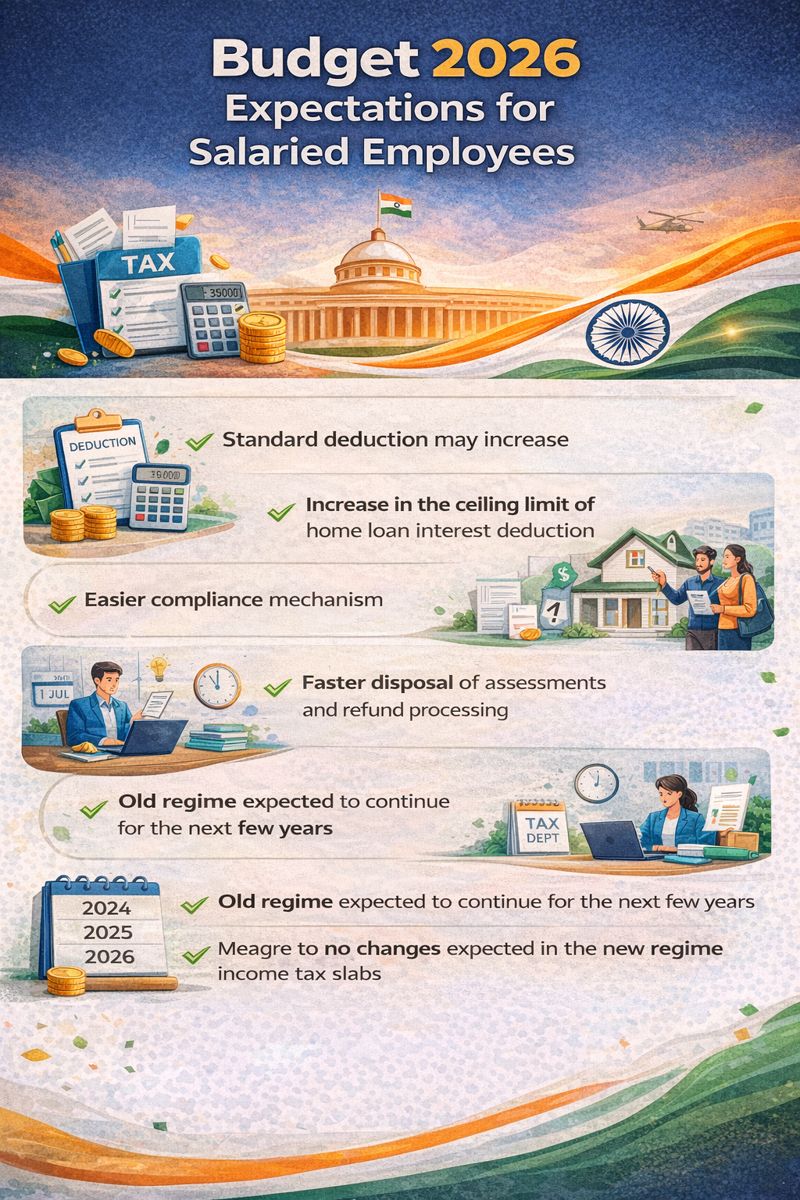
As the Union Budget 2026 approaches, income taxpayers are closely tracking announcements that could reshape India’s personal tax framework. Following the significant changes introduced to the new tax regime last year, the focus has now shifted to the future of the old tax regime—whether it will continue alongside, undergo modifications, or be phased out gradually. Expectations include possible revisions to tax slabs and rebates, selective deductions under the new regime, and targeted concessions for senior citizens and long-term investors. Simplification of compliance, quicker refunds, and a reduction in tax-related disputes are also high on the wish list. While sweeping tax cuts may be unlikely, Budget 2026 is expected to provide clear direction on the evolution of India’s income tax system, making it especially important for salaried taxpayers, retirees, homebuyers, and investors.
11:07 AM IST, 30 Jan 2026
Union Budget 2026 News Live: AI Excellence
“As businesses integrate AI, MarTech, and AdTech into their core operations, the clarity and direction provided by the Union Budget become critical for sustained digital growth. Last year’s Budget delivered a substantial ₹2,000 crore allocation to the IndiaAI Mission and ₹500 crore for a Centre of Excellence in AI , signalling strong intent.
11:05 AM IST, 30 Jan 2026
Union Budget 2026 News Live: Viksit Bharat
The goals of NEP 2020 and the broader Viksit Bharat agenda depend on expanding higher education while maintaining quality and global competitiveness. Achieving a 50% gross enrolment ratio will require consistent, long-term funding of around USD 30 billion, backed by policy frameworks that support affordable, long-duration financing and prudent access to capital markets for educational institutions.
Jan 27, 2026 13:57 IST
Union Budget Expectations 2026 Live Updates: Drone Manufacturing Industry
“The Union Budget is a key opportunity to accelerate India’s drone and deep-tech ecosystem through an infrastructure-first approach. Strengthening Drone Shakti through incentive-based manufacturing will clearly signal India’s shift from pilot adoption to large-scale expansion of the drone economy. Priority support for skill-linked training infrastructure, indigenous component manufacturing, and shared testing and certification facilities is essential to reduce import dependence and speed up innovation.
Industry Voices | January 23, 2026
| Sector | Key Budget Expectation |
|---|---|
| NBFC (Gold Loans) | Liberalising branch-opening norms for Gold Loan NBFCs and rationalising capital risk weights can accelerate credit flow to rural and lower middle-income segments, especially through lower-risk secured gold loans. |
| E-Mobility | Enhanced budget allocation for R&D in advanced materials, high-performance battery components, and next-generation energy storage solutions is critical to strengthening India’s long-term competitiveness in e-mobility. |
| NBFC (Finance & Infrastructure) | Continued support for India’s growth priorities with a strong focus on implementation—through timely execution of large infrastructure projects, smoother coordination, and reduced approval friction—will be key to improving productivity. |
| Manufacturing (Electronics) | Sustained policy support for domestic electronics manufacturing and stronger auxiliary ecosystems will help India transition into a global manufacturing hub. |
| Insurance | Building on the removal of GST on retail health insurance, the Union Budget 2026 should focus on improving coverage adequacy while maintaining affordability. |
12:33:09 PM IST, 22 Jan 2026
Union Budget 2026 News Live: India’s semiconductor push seeks a power shift
After years of policy announcements and initial approvals under the India Semiconductor Mission (ISM), the next phase will test whether the country can translate intent into sustained, on-ground execution while remaining competitive in an increasingly fractured global chip race.
11:45:09 AM IST, 22 Jan 2026
Union Budget 2026 News Live: Government gears up for all-party meeting on January 27
Union Parliamentary Affairs Minister Kiran Rijiju will convene an all-party meeting of floor leaders of both Houses of Parliament on January 27, ahead of the upcoming Budget Session.
As per sources, the meeting is scheduled to be held in the main Committee Room of Parliament.
11:22:31 AM IST, 22 Jan 2026
Union Budget 2026 News Live: AI, algorithms and cyber war: Will Budget 2026 redefine India’s battlefield?
According to BMI, it is expected to target a fiscal deficit of 4.3% of GDP in FY2026/27, even as fresh pressures build on defence and capital expenditure.
BMI, however, projects that the actual deficit could edge closer to 4.6%, underlining the challenge of balancing fiscal consolidation with rising strategic and security demands.
04:00:00 PM IST, 21 Jan 2026
Union Budget 2026 News Live: India seeks integrated push for nutraceuticals
The 2025 GST rationalisation was a game-changer for India’s nutraceutical sector, simplifying tax structures and easing costs for consumers. Budget 2026 is an opportunity to formally recognise food and dietary supplements as a core part of the country’s wellness ecosystem.
03:57:50 PM IST, 21 Jan 2026
Union Budget 2026 News Live: Can policy boost urban logistics, exporter-friendly SEZs?
India’s logistics and warehousing sector has benefited from sustained public capex, initiatives like PM Gati Shakti and the development of industrial corridors, which have strengthened connectivity and supported manufacturing expansion. As the sector scales, continued efforts to streamline environmental clearances and bring predictability to regulatory frameworks will be critical for timely project execution.
03:30:00 PM IST, 21 Jan 2026
Union Budget 2026 News Live: Can Budget help footwear sector move from volume to value?
India is the world’s second-largest footwear producer, yet remains under-indexed in value-added exports. Budget 2026 should focus on rationalising GST on premium footwear and leather accessories and correcting the inverted duty structure, which continues to pressure margins and consumer pricing.
02:47:05 PM IST, 21 Jan 2026
Union Budget 2026 News Live: Hospitality sector seeks GST relief, tourism push
The hospitality and food service sector reflects India’s evolving consumption story, driven by rising disposable incomes, experiential spending and renewed momentum in tourism and events. Continued focus on infrastructure development, tourism promotion and urban connectivity can deliver strong multiplier effects for the sector.
Hear from industry experts on pre-budget 2026-27
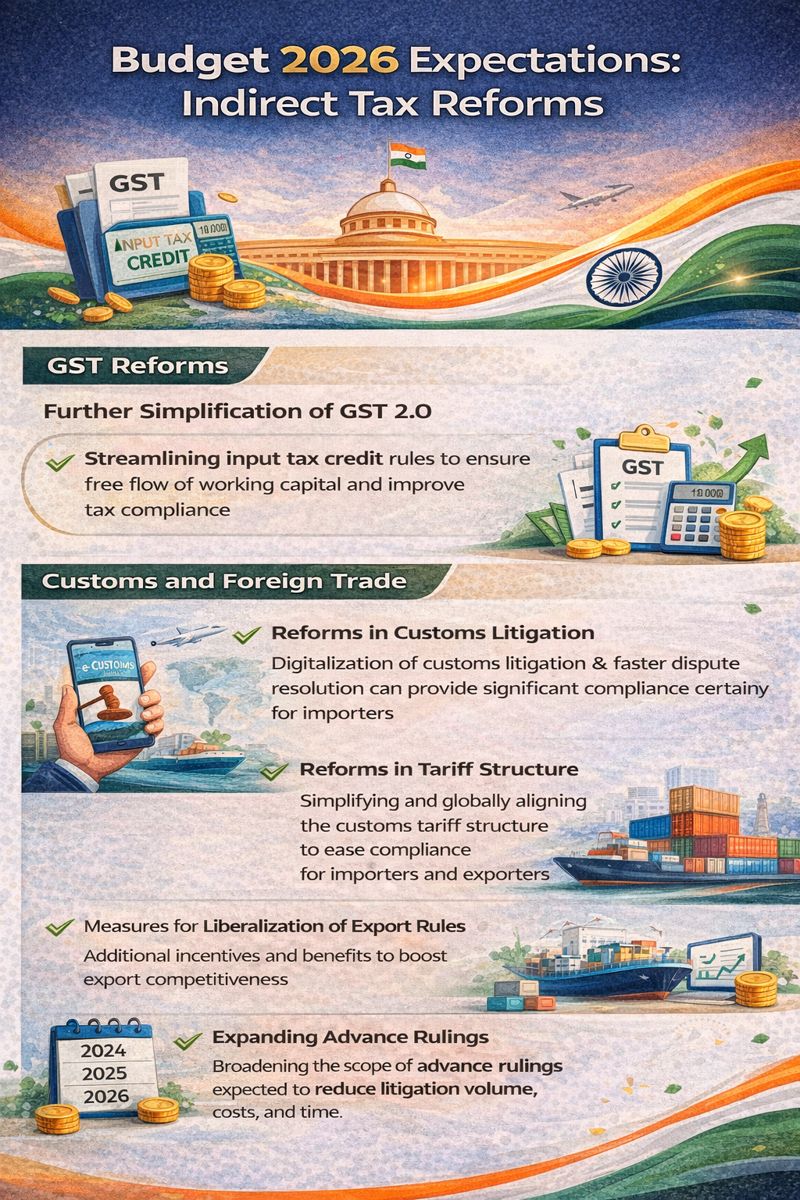
As Budget 2026 approaches, there is a strong expectation for meaningful GST reforms that simplify compliance and reduce litigation. Correcting place-of-supply rules for intermediary services, extending amnesty relief to Section 74 cases, and rationalising penalties for minor e-way bill violations can provide much-needed relief to genuine taxpayers and strengthen trust in the GST framework. — CA Rajesh Kumar Khandelwal
As Budget 2026 approaches, expectations are building around further income tax relief through a more attractive new tax regime, possible increases in standard deduction, and targeted support for middle-class and senior taxpayers. On the economic front, the focus is likely to remain on boosting domestic manufacturing, infrastructure spending, EV clarity, and research-led growth, while maintaining stability in capital gains taxation to support investor confidence. — Adv Gautam Sharma
Union Budget 2026–27 is expected to sustain India’s growth momentum while balancing fiscal discipline, as the economy targets long-term expansion toward a USD 5-trillion milestone. With GDP growth projected at around 7.4%, stakeholders anticipate simpler and more predictable tax laws, reduced litigation, smoother compliance, and clear transition under the new Income-tax Act from April 2026. — Kunal Soni
Union Budget 2026–27 is expected to focus strongly on easing compliance and improving liquidity for India’s MSMEs. Key direct tax expectations include higher presumptive taxation limits, relaxed tax audit requirements, faster dispute resolution, and greater certainty in restructuring provisions. On the GST side, businesses are looking for quicker refund processing, simplified export refund rules, easier treatment of post-sale discounts, and clearer place-of-supply provisions to reduce litigation. Overall, these reforms aim to lower compliance costs, strengthen working capital, improve export competitiveness, and create a more predictable, MSME-friendly tax environment that supports sustainable growth and investment confidence. — Dhara Gandhi
Why union budget 2026 is crucial?
Union Budget 2026 is seen as more than just an annual financial exercise. It is expected to:
- Strengthen India’s economic resilience amid global headwinds
- Maintain momentum in capital expenditure without widening fiscal stress
- Support long-term reforms rather than short-term populist measures
- Enable inclusive growth across urban, semi-urban, and rural India
With recommendations from the 16th Finance Commission set to influence fiscal transfers, this Budget will also define Centre–State financial dynamics for the next five years.
Read more: Union Budget Halwa Ceremony
What the fiscal signals suggest: Budget 2026
-
The fiscal deficit is likely to be maintained around 4.3% of GDP in FY27, indicating commitment to deficit reduction without sharply tightening spending.
-
Capital expenditure may rise by nearly 14%, reflecting continued emphasis on infrastructure, logistics, and connectivity to crowd in private investment and improve productivity.
-
Gross market borrowings are expected to increase, largely to fund higher capex outlays and meet debt redemption requirements, rather than to support revenue expenditure.
-
Direct tax collections are expected to remain the main driver of revenue growth, supported by formalisation and compliance gains, while GST growth may stay moderate, mirroring steady but unspectacular consumption trends.
Why this matters?
Overall, the fiscal approach points to policy continuity rather than expansionary surprises—prioritising long-term capacity building and asset creation over short-term stimulus. For businesses and investors, this suggests predictability in government spending, sustained infrastructure momentum, and limited risk of abrupt fiscal tightening.
Key sector expectations and policy priorities from Budget 2026
Infrastructure, housing, and urban development in focus
Real estate & housing
Industry leaders are calling for:
- Policy stability and faster approvals
- Infrastructure-led urban expansion in Tier 2 and Tier 3 cities
- Support for green and sustainable housing
- Measures to boost housing demand and NRI investments
A steady policy framework is seen as critical for maintaining investor confidence and housing-led economic growth.
Rail, roads & multimodal transport
Mobility and logistics are expected to remain central, with emphasis on:
- Rail modernisation and high-capacity corridors
- Multimodal transport integration
- Technology adoption and PPP models
- Reduced logistics costs and lower carbon footprint
Digital finance: Moving beyond adoption to impact
While India has achieved global leadership in digital payments, Budget 2026 is expected to focus on deepening digital finance usage, especially in rural and semi-urban areas.
Key themes include:
- Strengthening last-mile digital financial infrastructure
- Enhancing reliability and security of digital transactions
- Enabling small businesses and micro-entrepreneurs to fully participate in the formal economy
For MSMEs, this could translate into better access to credit, faster settlements, and improved financial visibility.
GST & taxation
Corporate India is largely seeking a predictable and reform-oriented Budget rather than headline-driven tax changes.
Notable GST-related expectations include:
- Rationalisation of GST structures in specific sectors
- Addressing rate mismatches, especially in emerging industries like electric mobility
- Simplifying compliance to reduce operational friction
For businesses, consistency and clarity in tax policies remain more valuable than short-term incentives.
Electric mobility & clean energy: Aligning policy with adoption
Electric vehicles
Industry participants have flagged GST inconsistencies—particularly the higher tax rate on EV batteries—as a barrier to faster adoption. Aligning GST rates across EVs and core components could:
- Reduce total ownership costs
- Enable innovative models like battery-as-a-service
- Accelerate adoption among commercial and fleet users
Renewables & green hydrogen
The clean energy sector is looking for:
- Support for energy storage and hybrid projects
- Incentives for domestic manufacturing
- Stronger push for green hydrogen under the National Green Hydrogen Mission
These measures are seen as essential for India’s low-carbon industrial transition.
MSMEs, credit access & financial inclusion
Access to affordable, formal credit remains a major theme ahead of Budget 2026.
Key expectations include:
- Greater recognition of secured lending models for first-time borrowers
- Support for digital credit innovations
- Lower cost of funds for NBFCs serving under-banked segments
Such measures could strengthen consumption, entrepreneurship, and financial resilience at the grassroots level.
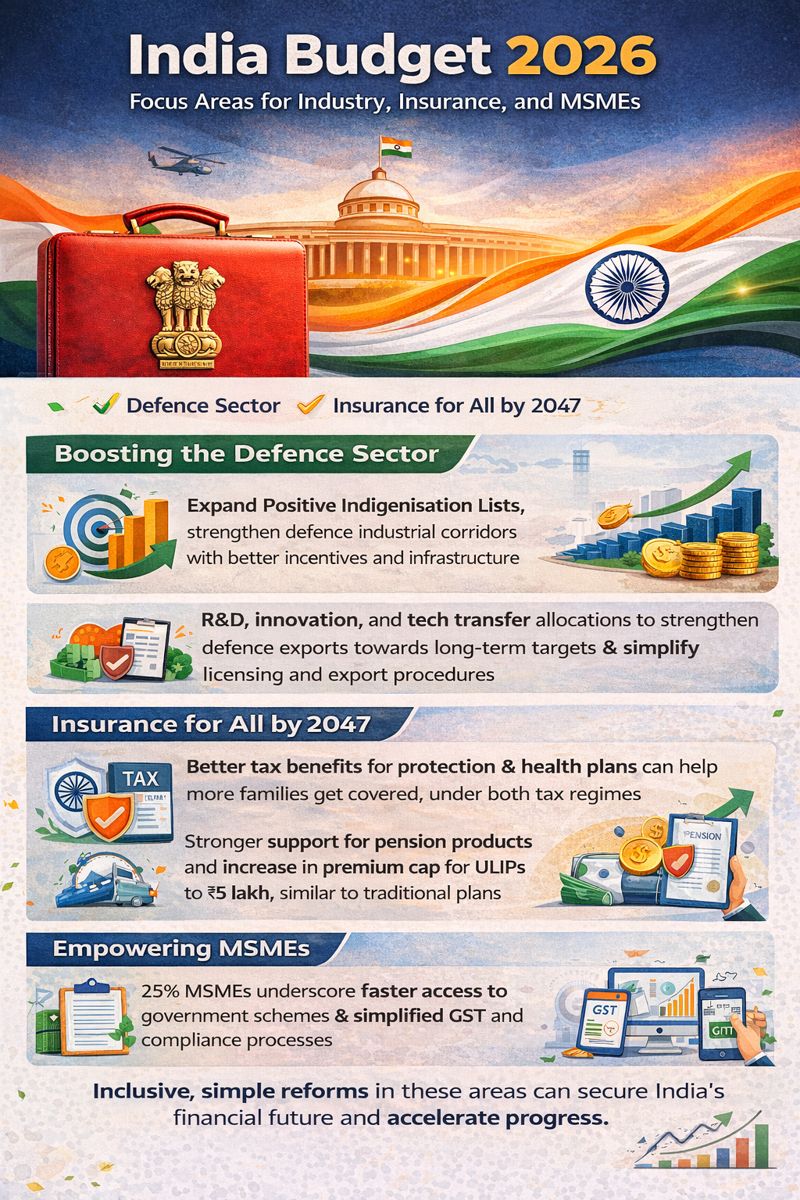
Insurance, healthcare & pharma innovation
Insurance
The general insurance sector is transitioning from rapid expansion to sustainable growth. Budget expectations include:
- Incentives for micro-insurance and social sector coverage
- Measures to improve affordability and penetration
- Stronger risk governance frameworks
Pharmaceuticals & healthcare
The pharma industry is seeking:
- Simplification of tax provisions affecting R&D
- Restoration of weighted tax deductions for in-house research
- Support for innovation in diagnostics, anti-infectives, and medical technology
Healthcare innovation is increasingly viewed as both an economic and public health priority.
Technology, AI & skilling the workforce
Union Budget 2026 is also expected to place technology at the heart of employment and skilling strategies.
Stakeholders are advocating:
- Use of AI-driven tools for large-scale skilling and career readiness
- Purpose-built learning technologies that deliver measurable outcomes
- Stronger alignment between education, employability, and industry needs
A national focus on “technology-enabled inclusion” could help bridge the gap between qualifications and jobs.
Tourism, hospitality & creative economy
Tourism & hospitality
The sector is seeking:
- Infrastructure status for hospitality
- Better connectivity to tourism clusters
- GST rationalisation and input tax credit support
- Incentives for niche tourism segments such as medical, sustainable, and MICE tourism
Creative & digital economy
There is growing emphasis on:
- Supporting original IP creation
- Incentivising export-oriented creative industries
- Simplifying tax frameworks for digital and IP-led businesses
These sectors are seen as high-potential job creators for India’s youth.
What businesses should watch out for in budget 2026?
Based on expert opinions, businesses should be prepared for possible changes in:
- Tax structures and slabs
- Compliance timelines and reporting
- MSME-focused incentives
- Digital compliance requirements
Final thoughts
Union Budget 2026 is shaping up to be a reform-driven, stability-focused budget, prioritising long-term growth over short-term announcements. With sustained capex, digital deepening, clean energy push, and technology-led skilling, the budget is expected to strengthen India’s economic foundation while keeping fiscal risks in check.
For businesses, staying informed and prepared will be key to navigating the opportunities and changes that follow.
Archieves
Union Budget 2024: Key Highlights
Get detailed archives of previous Union Budgets
Interesting facts about the Indian Union Budget
Record-breaking Budget speeches
-
Longest speech (by duration): Finance Minister Nirmala Sitharaman delivered the longest Budget speech in 2020–21, speaking for 2 hours and 42 minutes, surpassing her own 2019 record.
-
Longest speech (by word count): Manmohan Singh’s 1991 Budget remains the most detailed, with 18,650 words, presented during India’s economic crisis.
-
Shortest speech: In 1977, Hirubhai Mulljibhai Patel delivered the briefest Budget speech, comprising just 800 words.
Who presented the most Budgets
-
Morarji Desai holds the record for presenting the highest number of Union Budgets (10), followed by P. Chidambaram (9), Pranab Mukherjee and Yashwant Sinha (8 each).
How Budget traditions evolved
-
Until 1999, Budgets were presented at 5 PM; this shifted to 11 AM under Yashwant Sinha.
-
Since 2017, the Union Budget has been presented on February 1, advancing the earlier end-February schedule.
-
Budget documents were printed only in English until 1955, after which Hindi editions were introduced.
-
The 2021–22 Budget marked India’s first paperless Budget, introduced during the Covid-19 pandemic.
Women and the Union Budget
-
Nirmala Sitharaman became the second woman Finance Minister to present the Union Budget in 2019, after Indira Gandhi.
-
She also replaced the traditional briefcase with a ‘bahi-khata’, signalling a move toward Indian tradition.
Railway Budget merger
-
After being presented separately for over nine decades, the Railway Budget was merged with the Union Budget in 2017.
Iconic Budgets that shaped India
-
1973–74 ‘Black Budget’: Reflected severe fiscal stress during an economic downturn.
-
1986 ‘Carrot and stick Budget’: Initiated early reforms and introduced MODVAT to reduce tax cascading.
-
1991 ‘Epochal Budget’: Laid the foundation for economic liberalisation amid a balance-of-payments crisis.
-
1997 ‘Dream Budget’: Lowered tax rates to improve compliance and revenue mobilisation.
-
2000 ‘Millennium Budget’: Accelerated growth in India’s IT sector.
-
2002–03 ‘Rollback Budget’: Remembered for reversing several announced measures.
-
2021 ‘Once-in-a-century Budget’: Focused on infrastructure, healthcare, and privatisation to revive the post-pandemic economy.