Time-based billing is widely used in India for professional services where clients are billed on the basis of hours spent on the subject. It is seen when the time taken to render a service varies with each engagement.
With planning and documentation, and by using time billing software, Indian service firms can bill by time under GST compliance and keep the clients informed.
This blog post explains how professional service firms can create and manage time-based billing using structured processes and reliable billing software.
What time-based billing means for professional services
Under time-based billing, the client is charged for every hour or minute spent on a particular activity or project, and a record of work is multiplied by a defined unit price.
In India, it is common for service professionals to adopt this model, since it is not feasible to provide estimates of the cost of services, and the final price is based on the client's requirements, the changes, the meetings, and the after-sales service.
For time-based billing to work, businesses need:
- Clearly defined hourly or daily rates
- Accurate time tracking
- GST-compliant invoicing
- Proper client agreements
Professional services in India that use time-based billing
For service-based businesses in India, time-based billing is the most effective model due to the nature of the work. Such businesses can include:
- Chartered accountants and tax consultants
- Legal professionals and law firms
- Architects and interior designers
- IT consultants and software service providers
- Management and business consultants
The services frequently involve either consulting, compliance, or project work, which are subject to considerable variation among customers. Billing by the hour allows the firm to charge fairly and provides the client with a transparent bill.
How time-based billing works under GST in India
Professional services in the Indian GST system are covered under the term ‘supply of services’ and are taxable under GST at the applicable GST rate (usually 18% for most consultancy and professional services).
Important GST aspects relevant to time-based billing include:
- Time of supply: GST is payable when someone issues an invoice, or someone makes a payment, whichever occurs earlier.
- Invoice requirements: An invoice must include the GSTIN, invoice number, invoice date, a description or nature of service, taxable value, GST rate, and tax amount.
- Place of supply: Place of supply determines whether CGST/SGST or IGST will apply.
Even where a fee is based on time, GST is charged on the value of the services over the billing period.
Steps to set up time-based billing for your business
Time-based billing also requires businesses to determine a time-tracking structure, decide what to bill time for, and create invoices that comply with GST regulations.
The following are steps for professional service firms in India to establish and successfully implement a system of time-based rates.
Step 1: Define billable activities and rates
First, you need to clarify what is considered a billable activity. In our case, client meetings, advisory, written deliverables, audits, and project implementation activities are billable, but internal reviews and administrative responsibilities at the company are assumed to be free.
To set rates:
- Calculate business overheads such as rent, utilities, and software costs
- Check the rates charged by similar professionals in India
- Factor in experience level and service value
Rates may vary by role, seniority, or type of work.
Step 2: Track time spent on client work
Time-based billing works best when time tracking is done well. Each task the person works on should be recorded on a daily basis with a description of how the time was spent from the client's perspective.
On the Indian side, these service companies often use digital applications to track billable hours per client and assignment and reduce disputes, providing audit trails and invoices.
Keep these time records for your business records, and in case of a GST audit or client inquiry.
Step 3: Set clear contractual terms with clients
When undertaking time-based billing, you must have a written service agreement in place, which should specify:
- Hourly or daily rates
- Scope of work
- Billing cycle
- Payment terms
- What counts as billable time
Late payment clauses should be included to protect cash flow and clarify expectations from the outset.
Step 4: Generate GST-compliant invoices
Each time-based service invoice must meet the GST requirements. Each invoice should include:
- Business name and GSTIN
- Client details and GSTIN, where applicable
- Invoice number and date
- Description of services with hours and rates
- Taxable value and GST breakup
- Total amount payable
Sending out invoices on a regular basis (such as monthly or upon finishing a project) can help.
Common billing challenges faced by Indian service providers
Service businesses using time-based billing often face challenges such as:
- Missed or inaccurate time entries
- Disputes with clients over billable hours
- Errors in GST calculation
- Delays in invoice generation
These risks affect both cash flow and legal compliance. To reduce such problems, companies typically use business billing software and processes.
Using billing software to manage time-based billing
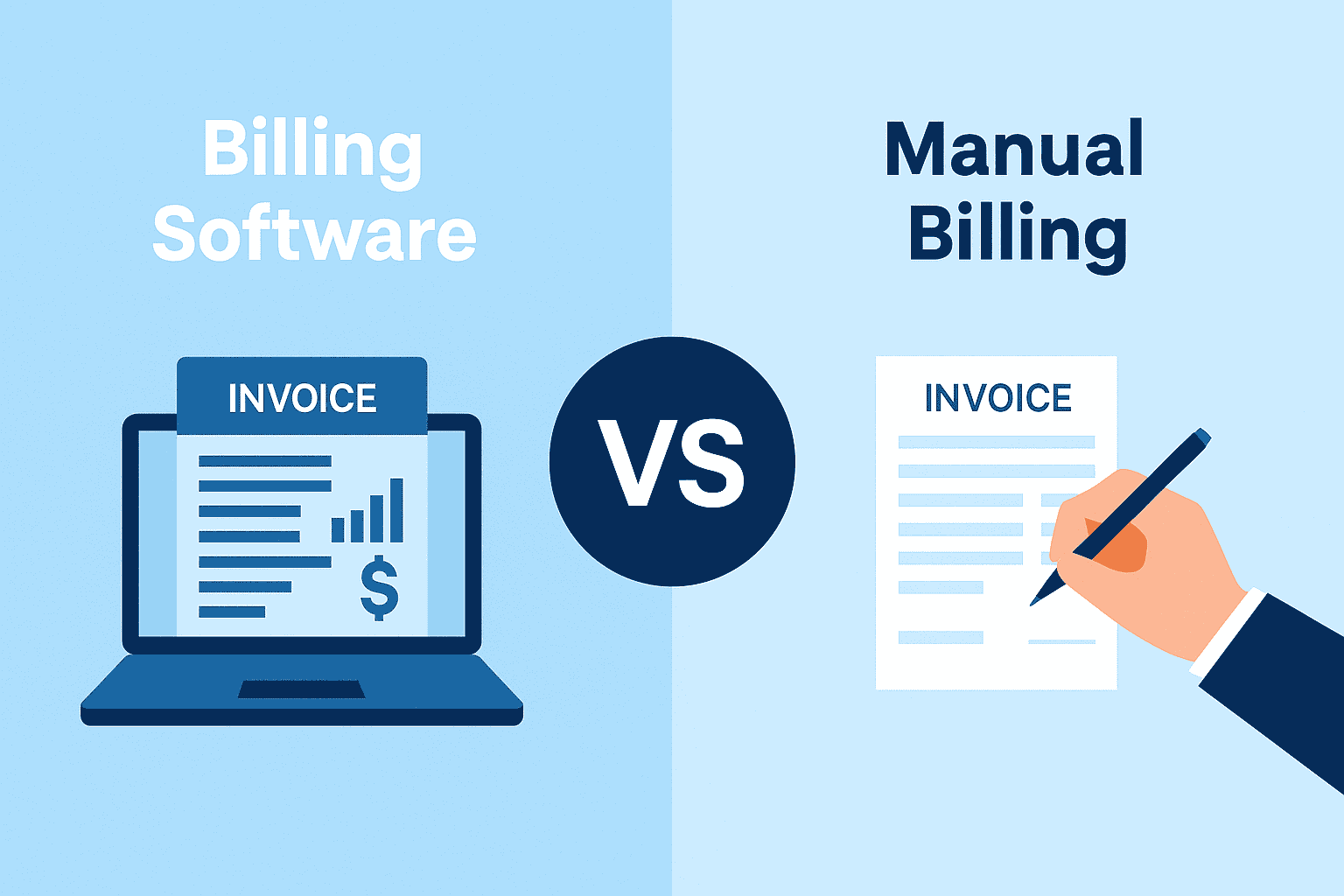
Billing software helps automate major parts of the time-based billing process. It allows businesses to:
- Track billable hours
- Convert time entries into invoices
- Apply GST automatically
- Maintain digital records for audits
For small firms, small business billing software reduces manual effort and improves billing accuracy. Larger practices often rely on business billing software to manage multiple clients, service rates, and tax rules in one place.
How TallyPrime supports time-based billing for services
TallyPrime allows service-sector firms in India to create structured invoices and meet GST regulations. It lets users create service ledgers and GST rates, and create invoices that apply time-based service charges.
With TallyPrime, service providers can:
- Keep service records for clients
- Create GST-compliant service invoices
- Track outstanding payments and receivables.
- Maintain audit-ready books
With a unified accounting and billing system, firms also avoid the manual reconciliation process and remain compliant with Indian tax regulations.
Conclusion
Time-based billing suits many professional services in India, where work effort changes from client to client. When supported by clear agreements, accurate time tracking, and GST-compliant invoicing, this billing method improves transparency and financial control.
For Indian service businesses managing time-based billing alongside GST compliance, using an integrated solution like TallyPrime can help streamline invoicing, accounting, and ongoing financial tracking within a single system.